Lighting
Links
- Visual art
- CG
- Lighting guides
- [Гарни - Цвет и Свет](<file:///E:\Keerah\Documents\My Docs\CG\Dzheyms_Garni_-_Tsvet_i_svet.pdf>)
TOC
Description
Lighting or illumination is the deliberate use of light to achieve practical or aesthetic effects. Lighting includes the use of both artificial light sources like lamps and light fixtures, as well as natural illumination by capturing daylight. Daylighting (using windows, skylights, or light shelves) is sometimes used as the main source of light during daytime in buildings. This can save energy in place of using artificial lighting, which represents a major component of energy consumption in buildings. Proper lighting can enhance task performance, improve the appearance of an area, or have positive psychological effects on occupants.
Indoor lighting is usually accomplished using light fixtures, and is a key part of interior design. Lighting can also be an intrinsic component of landscape projects.
Computer graphics lighting
Computer graphics lighting is the collection of techniques used to simulate light in computer graphics scenes. While lighting techniques offer flexibility in the level of detail and functionality available, they also operate at different levels of computational demand and complexity. Graphics artists can choose from a variety of light sources, models, shading techniques, and effects to suit the needs of each application.
Light sources
Point
Point sources emit light from a single point in all directions, with the intensity of the light decreasing with distance. An example of a point source is a standalone light bulb.
Directional
A directional source (or distant source) uniformly lights a scene from one direction. Unlike a point source, the intensity of light produced by a directional source does not change with distance over the scale of the scene, as the directional source is treated as though it is extremely far away. An example of a directional source is sunlight on Earth.
Spotlight
A spotlight produces a directed cone of light. The light becomes more intense as the viewer gets closer to the spotlight source and to the center of the light cone. An example of a spotlight is a flashlight.
Area
Area lights are 3D objects which emit light. Whereas point lights and spot lights sources are considered infinitesimally small points, area lights are treated as physical shapes. Area light produce softer shadows and more realistic lighting than point lights and spot lights.
Ambient
Ambient light sources illuminate objects even when no other light source is present. The intensity of ambient light is independent of direction, distance, and other objects, meaning the effect is completely uniform throughout the scene. This source ensures that objects are visible even in complete darkness.
Lightwarp
A lightwarp is a technique of which an object in the geometrical world refracts light based on the direction and intensity of the light. The light is then warped using an ambient diffuse term with a range of the color spectrum. The light then may be reflectively scattered to produce a higher depth of field, and refracted. The technique is used to produce a unique rendering style and can be used to limit overexposure of objects. Games such as Team Fortress 2 use the rendering technique to create a cartoon cel shaded stylized look.
HDRI
HDRI stands for High dynamic range image and is a 360° image that is wrapped around a 3D model as an outdoor setting and uses the sun typically as a light source in the sky. The textures from the model can reflect the direct and ambient light and colors from the HDRI.
Lighting interactions
In computer graphics, the overall effect of a light source on an object is determined by the combination of the object's interactions with it usually described by at least three main components. The three primary lighting components (and subsequent interaction types) are diffuse, ambient, and specular.
Diffuse
Diffuse lighting (or diffuse reflection) is the direct illumination of an object by an even amount of light interacting with a light-scattering surface. After light strikes an object, it is reflected as a function of the surface properties of the object as well as the angle of incoming light. This interaction is the primary contributor to the object's brightness and forms the basis for its color.
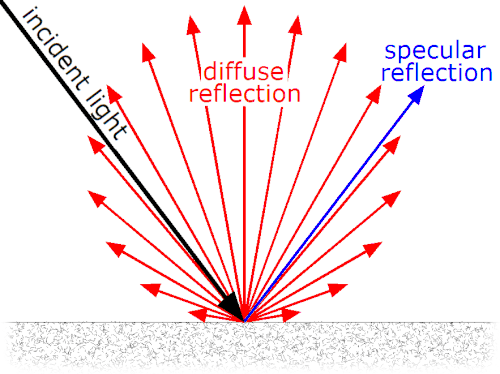
Diffuse reflection is the reflection of light or other waves or particles from a surface such that a ray incident on the surface is scattered at many angles rather than at just one angle as in the case of specular reflection. An ideal diffuse reflecting surface is said to exhibit Lambertian reflection, meaning that there is equal luminance when viewed from all directions lying in the half-space adjacent to the surface.
A surface built from a non-absorbing powder such as plaster, or from fibers such as paper, or from a polycrystalline material such as white marble, reflects light diffusely with great efficiency. Many common materials exhibit a mixture of specular and diffuse reflection.
The visibility of objects, excluding light-emitting ones, is primarily caused by diffuse reflection of light: it is diffusely-scattered light that forms the image of the object in an observer's eye over a wide range of angles of the observer with respect to the object.
Ambient
As ambient light is directionless, it interacts uniformly across all surfaces, with its intensity determined by the strength of the ambient light sources and the properties of objects' surface materials, namely their ambient reflection coefficients.
Specular
The specular lighting component gives objects shine and highlights. This is distinct from mirror effects because other objects in the environment are not visible in these reflections. Instead, specular lighting creates bright spots on objects based on the intensity of the specular lighting component and the specular reflection coefficient of the surface.
Microfacets
The term specular means that light is perfectly reflected in a mirror-like way from the light source to the viewer. Specular reflection is visible only where the surface normal is oriented precisely halfway between the direction of incoming light and the direction of the viewer; this is called the half-angle direction because it bisects (divides into halves) the angle between the incoming light and the viewer. Thus, a specularly reflecting surface would show a specular highlight as the perfectly sharp reflected image of a light source. However, many shiny objects show blurred specular highlights.
This can be explained by the existence of microfacets. We assume that surfaces that are not perfectly smooth are composed of many very tiny facets, each of which is a perfect specular reflector. These microfacets have normals that are distributed about the normal of the approximating smooth surface. The degree to which microfacet normals differ from the smooth surface normal is determined by the roughness of the surface. At points on the object where the smooth normal is close to the half-angle direction, many of the microfacets point in the half-angle direction and so the specular highlight is bright. As one moves away from the center of the highlight, the smooth normal and the half-angle direction get farther apart; the number of microfacets oriented in the half-angle direction falls, and so the intensity of the highlight falls off to zero.
The specular highlight often reflects the color of the light source, not the color of the reflecting object. This is because many materials have a thin layer of clear material above the surface of the pigmented material. For example, plastic is made up of tiny beads of color suspended in a clear polymer and human skin often has a thin layer of oil or sweat above the pigmented cells. Such materials will show specular highlights in which all parts of the color spectrum are reflected equally. On metallic materials such as gold the color of the specular highlight will reflect the color of the material.
Models
A number of different models exist to predict the distribution of microfacets. Most assume that the microfacet normals are distributed evenly around the normal; these models are called isotropic. If microfacets are distributed with a preference for a certain direction along the surface, the distribution is anisotropic.
Phong distribution
Phong reflection model
Gaussian distribution
A slightly better model of microfacet distribution can be created using a Gaussian distribution.
Beckmann distribution
A physically based model of microfacet distribution is the Beckmann distribution.
Heidrich–Seidel anisotropic distribution
The Heidrich–Seidel. distribution is a simple anisotropic distribution, based on the Phong model. It can be used to model surfaces that have small parallel grooves or fibers, such as brushed metal, satin, and hair.
Ward anisotropic distribution
The Ward anisotropic distribution uses two user-controllable parameters
Cook–Torrance model
Illumination models
Lighting models are used to replicate lighting effects in rendered environments where light is approximated based on the physics of light.] Without lighting models, replicating lighting effects as they occur in the natural world would require more processing power than is practical for computer graphics.] This lighting, or illumination model's purpose is to compute the color of every pixel or the amount of light reflected for different surfaces in the scene.] There are two main illumination models, object oriented lighting and global illumination. They differ in that object oriented lighting considers each object individually, whereas global illumination maps how light interacts between objects.
Object oriented lighting
Object oriented lighting, also known as local illumination, is defined by mapping a single light source to a single object. This technique is fast to compute, but often is an incomplete approximation of how light would behave in the scene in reality. It is often approximated by summing a combination of specular, diffuse, and ambient light of a specific object. The two predominant local illumination models are the Phong and the Blinn-Phong illumination models.